Living in Iceland · Winter
Getting ready for winter
Start with your car if you drive. Then get your clothes and shoes ready, prepare for dark mornings, and sort out the everyday things you and your children need.
Last verified 7 October 2026 · Reykjavíkurborg (reykjavik.is/nagladekk)
If I drive, what should I get ready first?
Book your tyre change early, before the first snow. Appointments can fill up when the cold weather arrives.
- Winter tyres in good condition before the snow comes. Studded tyres (nagladekk, say: NAG-la-dek) are allowed from 1 November to mid-April, and are not allowed from 15 April to 31 October unless the weather forces it.
- The law asks for at least three millimetres of tread on winter tyres. Check it now, not in the first storm.
- An ice scraper and a snow brush that live in the car.
- A spare pair of gloves and a scarf that never come home. You will lose the pair you are wearing, and you will need these.
- No garage? Leave home ten minutes early to clear snow and ice off the car.
- Check road conditions on umferdin.is before you set out.
Not sure whether your tyres are still good for winter? You do not have to decide on your own. Drive to a tyre shop and ask them to look. They check tyres all day and can tell you in a minute whether the ones on your car are ready. Shops that sell tyres do this too.
- Look for the word dekk (say: DEHKK, tyres) or a tyre shop sign. Nesdekk is one chain with workshops in Reykjavík, Hafnarfjörður, Garðabær, Mosfellsbær, Reykjanesbær, Akureyri and Selfoss.
- Many tyre shops take booked visits only, so book a time or call before you drive there.
- Ask whether a check costs anything. Some shops charge for the work they do on the car.
Editor's note: the person who writes this page drove to a tyre shop last year when she was not sure, and expected to be sold new tyres. They looked and said her tyres were fine for winter. Other shops may suggest new tyres. Ask for the price before any work starts.
The tyre dates are published by the authorities each year. See Reykjavík city on studded tyres and our driving page.
What clothes do I need for everyday winter life?
- A wool first layer (top and leggings) worn next to the skin.
- A warm middle layer, such as a fleece or wool jumper.
- A windproof and waterproof outer jacket. This is the one worth paying for.
- Hat, warm gloves and a neck warmer.
- Where to buy: Costco, Rúmfatalagerinn, Hagkaup, the sports shops, and second-hand shops like Rauði krossinn, Góði hirðirinn and Hertex.
- Autumn is the good time to buy winter clothes second-hand, before the best sizes go.
What shoes do people wear in an Icelandic winter?
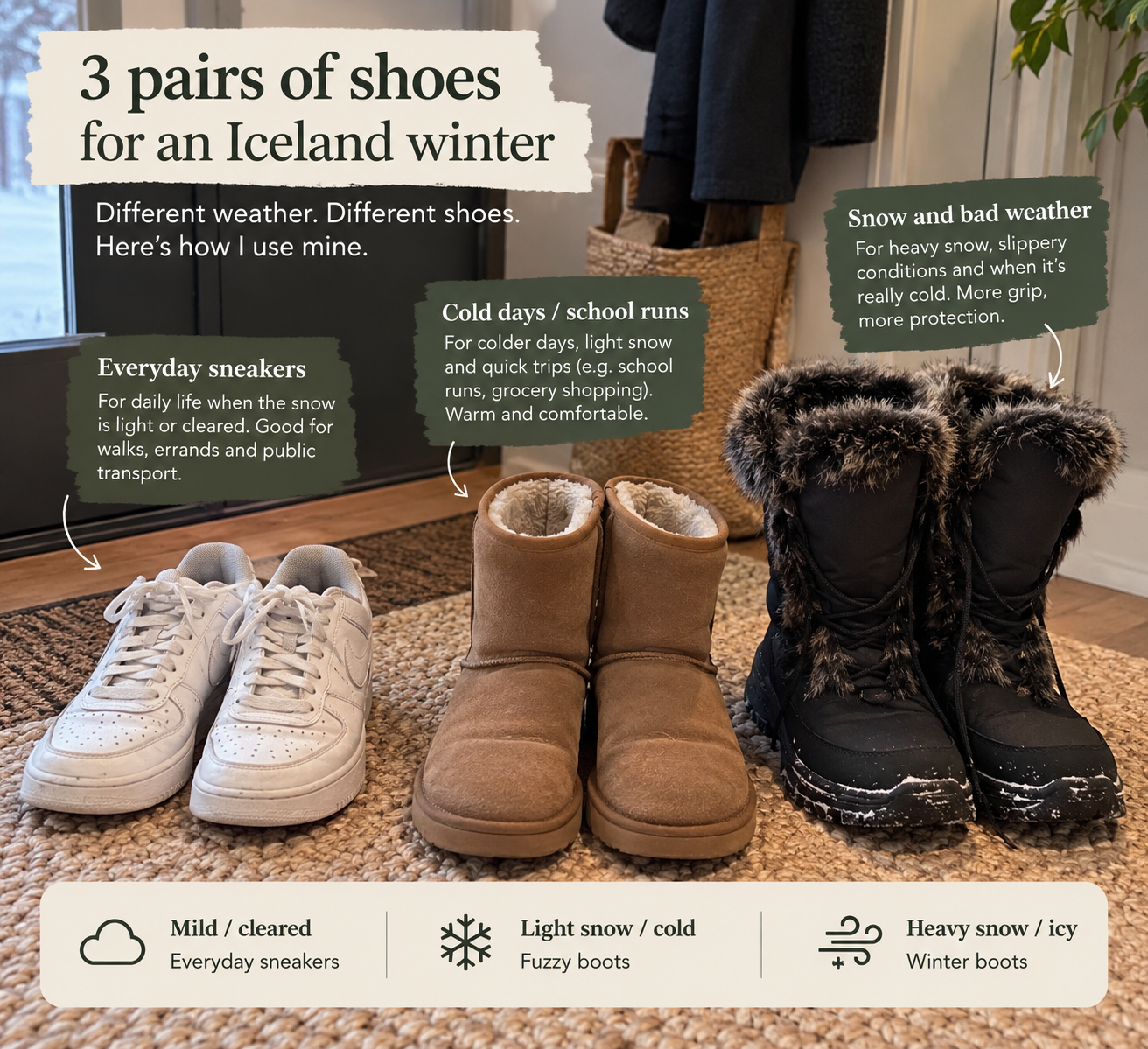
- Everyday sneakers: this is why you see so many people in white leather sneakers, like Nike. Leather keeps out wind and light snow. You wear the same pair in summer, so you do not need to buy a winter pair.
- Buy them half a size bigger, for example 38.5 instead of 38. Then thick wool socks fit in winter without squeezing your toes.
- New Balance and other soft sneakers are also very comfortable. The only problem is rain and slush, because they let water in.
- Warm fuzzy boots (like UGG, or cheaper brands): good for cold days, light snow, school runs and shopping. Easy to take off at the door. Spray them with waterproof spray before winter, or they can stop keeping water out.
- Real winter boots: for heavy snow, ice and wet slush. Waterproof, with a thick, grippy sole.
- Going somewhere new, walking far, or not sure about the weather? Wear the winter boots.
- Shoe spikes (mannbroddar, say: MAN-brod-ar) for icy days. Keep them in your bag.
- Wool socks, so a wet shoe does not mean a cold day.
What do I need for walking in the dark and on ice?
- Wear a reflector (endurskinsmerki, say: EN-dur-skins-mer-ki) on your coat or bag. Drivers see you far sooner than you think.
- On ice, take short steps and keep your hands out of your pockets.
- Assume the pavement in front of your building is ice until you have tested it.
How can I care for dry skin and lips?
The air inside is dry from the heating and the wind outside strips moisture off your skin. Most people here get dry skin every winter. This is the routine that works.
- Morning: body cream first, then a layer of oil over it, before you leave the house.
- Evening: the same again, after a shower, while the skin is still slightly damp.
- A thick, moisturising lip balm and a hand cream. Keep one in your bag and one at your desk.
- Choose a thick cream rather than a light lotion. A cream with oil, urea or ceramides in it lasts better here.
Editor's note: this is what works for the person who writes this page, not official advice. Any good thick cream and any plain body oil will do.
What about vitamin D in winter?
- Take vitamin D every day through the winter, for example cod liver oil (lýsi, say: LEE-see) or capsules.
- It is cheap, it is sold in every supermarket and pharmacy, and it is the standard advice here.
The amounts Iceland recommends, and why they are higher than elsewhere, are on this page: The dark winter: vitamin D, mood and where to get help.
What should I leave at my child’s daycare or school?
Every school sends its own list, so ask for theirs. These are the things Icelandic daycare centres normally ask parents to keep in the child's cubby.
- A waterproof winter suit (kuldagalli, say: KUL-da-gat-li) and waterproof trousers.
- A fleece or wool middle layer (flíspeysa) and wool socks.
- A hat, mittens and a neck warmer rather than a scarf.
- Spare socks, trousers and a long-sleeved top in the cubby, in case everything gets wet.
- Mark everything with the child's name. Nothing comes back unmarked.
Two examples of the lists schools send: Reykhólaskóli and Garðasel.
Weather, roads and the dark winter
The dark itself, vitamin D and winter mood: the dark winter. Storms, closed roads and what they mean for work and school: weather warnings and roads. Buses and walking in winter: getting around.
Now sit still and wait for the sun to come again.
Was this page helpful?
We are still building this site. If something was missing, wrong, or hard to understand, tell us. One line is enough. You do not have to give your name, and we do not track you.
Write to hello@yourcompanion.is
Tell us what you were looking for and what you could not find. It is how the next version of this page gets written.